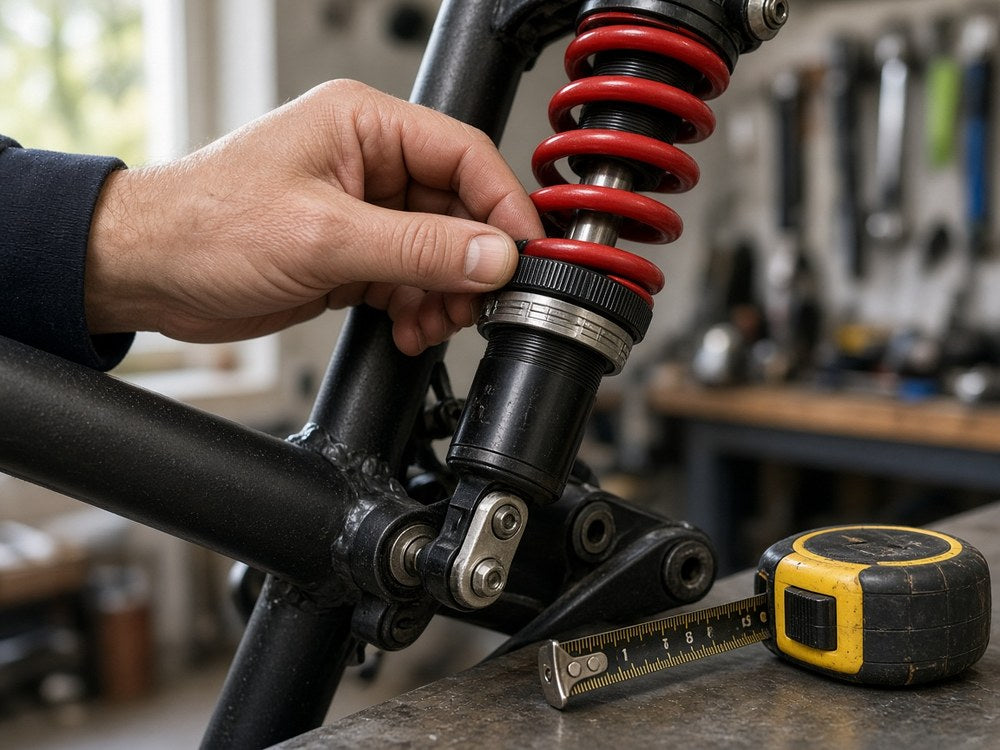

Matching eye-to-eye shock length is not enough to approve a replacement rear shock. Its stroke, mounting hardware, attachment style, and compatibility with the frame must also be correct, with clearance throughout suspension travel. A shock that bolts into the parked bicycle can still be unsuitable. Use the frame's approved replacement specification, not mounting length alone.
Match the stroke as well as the mounting length

Eye-to-eye length describes the distance between the mounting centers on an extended shock with eyelets. Stroke describes how far the shock compresses. They answer different fit questions.
Two shocks can share a mounting length but allow different amounts of compression. Do not assume that more stroke is a free increase in usable travel. The frame's suspension was designed around a particular arrangement, and the replacement must stay within its approved specification.
Check the markings on the original shock against the bicycle maker's information. If the original was already replaced, its markings are a clue rather than proof of the correct choice.
Also avoid confusing shock stroke with rear-wheel travel. A bicycle's advertised wheel-travel figure is not a shock-ordering dimension. When the correct specification is unclear, ask the frame maker or a suspension shop to identify it before buying.
Check the attachment and frame approval
Matching length and stroke still leaves the mounting arrangement. An eyelet-style attachment and a trunnion-style attachment are not interchangeable simply because a seller lists similar dimensions.
The correct hardware must suit both the shock and the frame's mounting points. Do not fill gaps with miscellaneous washers, drill an attachment, or reuse hardware solely because the bolt passes through it.
Some frame mounting layouts also restrict which shock constructions are suitable. That means a dimensionally similar coil or air shock is not automatically an approved substitute. Confirm the actual shock and frame combination, especially where the frame uses an extended mounting arrangement.
The shock absorber guide explains the broader suspension choices. Those general differences do not establish that a particular replacement can be fitted.
Have clearance checked through the full travel
A stationary bicycle shows only one suspension position. Clearance must remain correct as the suspension moves, including around the shock body, spring, frame, and linkage.
Have a qualified technician perform the applicable installation and clearance procedure. Do not remove a spring or release pressure just to push an unfamiliar assembly through its travel yourself. The method depends on the equipment, and getting the mounting length right does not remove those service risks.
If contact occurs or approval remains uncertain, reject that replacement. Changing sag is not a way to hide interference. Setup comes after compatibility and installation are established.
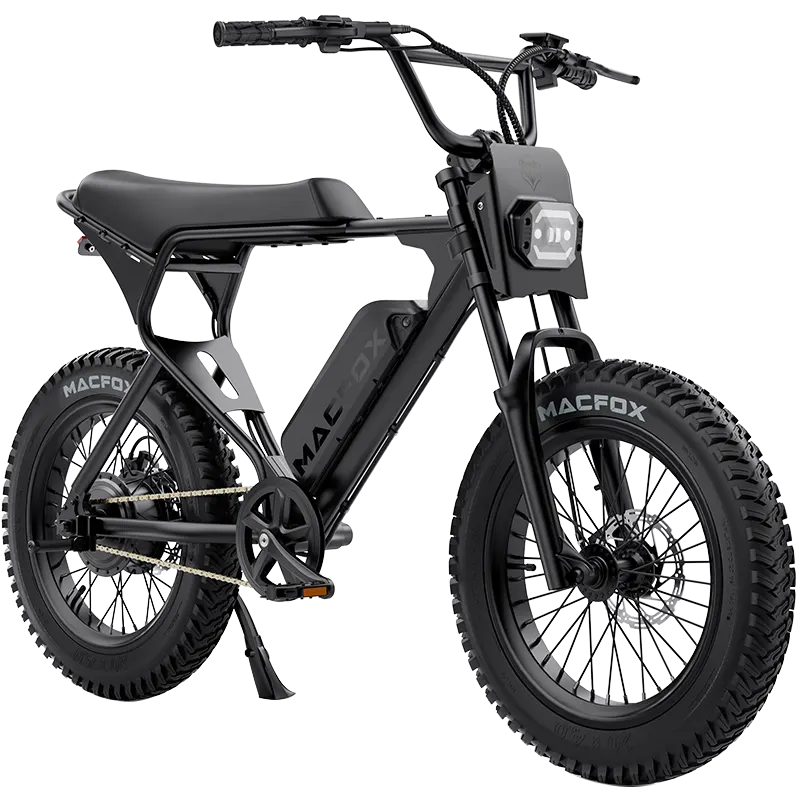
When comparing electric bikes, check the suspension actually supplied and the available replacement support. A familiar shock shape or a single length measurement tells you much less than a confirmed, frame-specific replacement route.