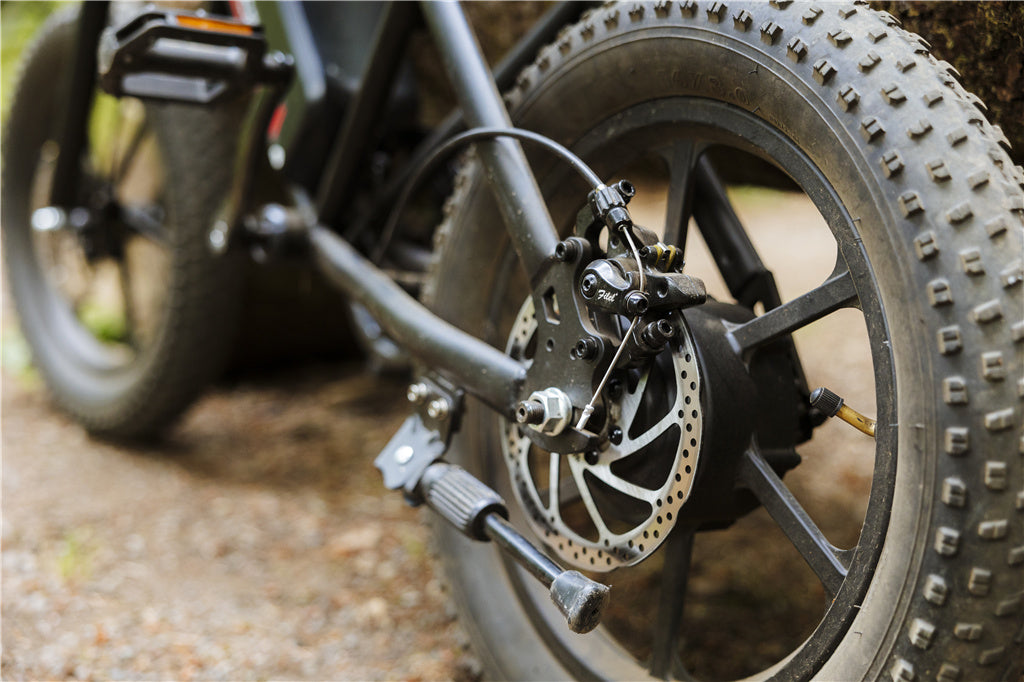

You center the caliper, spin the wheel, and hear no rubbing. Then you notice that one edge of a brake pad seems to miss the rotor. Is that just how the pad is shaped, or is something sitting in the wrong place?
Start by identifying what sticks out. An exposed metal backing plate is not the same as friction material overhanging the braking track. If the friction material really does extend beyond its intended contact area, pause riding and have the fit checked. A quiet wheel does not settle that question.
Look at the Friction Material, Not the Backing Plate

A disc brake pad has friction material attached to a metal backing plate. The plate may include a tab for retaining or handling the pad. That tab is not supposed to press against the rotor.
With the bike switched off, supported securely, and the brake cool, use a light to inspect the pad without touching either braking surface. Follow the friction material toward the rotor's outer edge and inward toward the hub. You are checking where that material meets the rotor's braking track, not whether every visible piece of metal lines up.
A raised, unworn edge on the friction material deserves attention. An unused strip of rotor, by itself, does not prove pad overhang. If the caliper hides the contact area, have a shop inspect it rather than deciding from the backing plate alone.
Centered Does Not Always Mean Correctly Positioned
Side-to-side centering sets the rotor between the pads. Radial position is different: it describes how far the pad sits toward the hub or the rotor's outer edge.
That distinction matters when following disc brake adjustment advice. Making the gaps even cannot fix the wrong rotor-and-adapter combination or a pad shape that does not suit the braking track. You can eliminate rubbing and still have a contact problem.
Check the Parts Together Before Riding
If this appeared after replacing a component, keep the old part number or packaging. For an electric bike with replacement brakes or rotors, identify the parts actually fitted rather than relying only on the bike's original specification.
Bring these details to the brake manufacturer or a qualified bike shop:
- The caliper model and replacement pad part number.
- The rotor model and diameter, not just its brand.
- The adapter's markings and orientation, plus the frame or fork's brake-mount specification.
These parts need to work as a combination. Matching the old rotor's diameter is not enough; the pad shape and braking track must also be compatible.
Do not file down a pad ledge, grind the mounting points, or add washers to make the contact look better. There is no universal amount of overhang to approve by eye.
Have the incompatible part or mounting issue corrected and the affected pads and rotor checked for wear. Before riding, the contact position and the manufacturer's applicable brake checks need to be right. Simply spinning without noise is not the finish line.