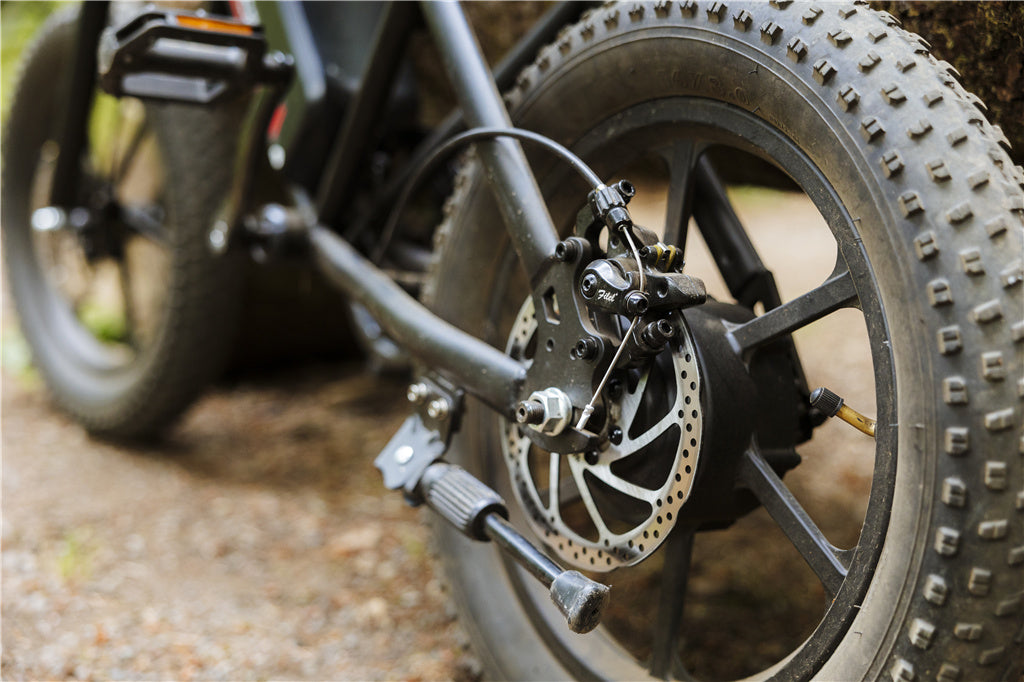

You notice a ridge at your brake rotor's edge, but your caliper says the rotor is still thick enough. Before trusting that number, check where the jaws landed. If they rest on an unworn lip, they can miss the thinner metal between them.
Find the Surface the Pads Actually Use

Let the rotor cool completely, turn off your e-bike, and keep the wheel still while measuring. Keep fingers away from its sharp edges and avoid touching the braking surface.
Look for the track swept by the brake pads. The outermost edge and the carrier near the hub may sit outside that contact area. A reading taken there does not tell you how much metal remains where braking happens.
If you see a crack or obvious deformation, stop using the rotor. A thickness measurement cannot make that damage acceptable.
Make Sure the Tool Reaches Past the Lip
Both measuring contacts need to reach the worn track, directly opposite each other. Rotors can wear into a shallow hollow, so broad, flat jaws resting across raised edges can give an overly generous reading.
A rotor-thickness gauge or a micrometer with suitable contact geometry can reach that surface. The important part is where it touches, not what the tool is called.
- Follow the instrument's setup and zeroing instructions, including any fitted attachments.
- Place the contacts on solid metal in the worn braking track, not across a hole or slot.
- If you cannot reach the track or repeat the reading reliably, have a bike shop measure it.
Do not file down the lip to make your tool fit, or subtract a guessed amount from an edge reading.
Compare a Reliable Reading With the Right Limit
Check several positions around the braking track, keeping the wheel stationary for each measurement. Record the lowest repeatable, valid reading. Averaging readings can hide a thinner area.
Rotors fitted to electric bikes do not all share one wear limit. Look for the minimum-thickness marking on your actual rotor, or find the current instructions for that exact model. Its diameter and original thickness are not its minimum service thickness.
At or below that minimum, stop using the rotor and arrange replacement. If the reading is close enough that measurement uncertainty could change the decision, get it checked rather than rounding up. Extra decimal places on a display do not prove the measurement is accurate.
A Thickness Check Has Limits
A lip is a reason to inspect, not a measurement by itself. Equally, a reading above the minimum is not proof that the entire brake is sound. Cracks, deformation, or weak braking still need attention before riding.
Disc brake adjustment addresses a different issue: pad position and alignment. Moving the caliper cannot restore metal worn off the rotor.
For a useful shop handoff, bring the rotor model, its specified minimum, and your lowest reliable reading. If you could only measure the lip, say so. That is a measurement still to be made, not a rotor cleared for another ride.