
Editor's Note: This article was updated on April 2, 2026.
If your riding is mainly for short last-mile trips, and you need something you can fold and carry onto a bus or subway, or bring into the office, an electric scooter is usually the better fit. If your rides are longer, or you want one vehicle that can handle daily commuting, exploration, and a more stable riding experience, an electric bike is usually the better long-term option. In today’s market, electric scooters generally have a lower entry price, with common price points around $300–$1,200 and real-world range often concentrated in the 10–30 mile range. Electric bikes usually cost more, with a typical practical range of about $1,000–$4,000, but commuter-oriented models also tend to offer longer range, often 20–60 miles or more.
Their Essential Differences

At the federal level in the United States, an electric bike generally refers to a two- or three-wheeled vehicle with fully operable pedals, a motor under 750W, and a maximum motor-powered speed below 20 mph. On top of that, many states further divide e-bikes into Class 1, 2, and 3 categories: Class 1 provides pedal assist up to 20 mph, Class 2 includes a throttle and tops out at 20 mph, and Class 3 provides pedal assist up to 28 mph.
An electric scooter, by contrast, is a stand-up micromobility vehicle that usually does not have a seat and is designed to be ridden standing on a deck. State laws in the U.S. do not define electric scooters uniformly, but the most common rules usually focus on top speed, sidewalk access, minimum rider age, helmet requirements, and road use.
So beyond the obvious visual difference, we can also see that the legal framework for electric bikes in the U.S. is generally more mature and more clearly defined, while electric scooter regulation is more fragmented and depends much more on the specific rules of each state and city.
Electric Scooter vs. Electric Bike: Quick Performance Comparison
| Category | Electric Scooter | Electric Bike |
|---|---|---|
| Typical Speed | Usually around 15–20 mph | Class 1 and Class 2 typically go up to 20 mph; Class 3 goes up to 28 mph |
| Typical Range | About 10–30 miles is most common; higher-spec commuter models may reach around 30–34 miles | About 20–60 miles is more common; range varies more depending on battery size |
| Riding Position | Mainly standing; seated versions exist but are not the mainstream choice | Mainly seated, closer to the feel of a traditional bicycle |
| Wheel Size & Stability | Typical wheel size is around 8.5–10 inches, which makes them more sensitive to cracks, potholes, and rough pavement | Typical wheel size is around 20–29 inches, which generally provides more stability and better tolerance for rough roads |
| Vehicle Weight | Usually around 30–50 lbs; many folding commuter models fall in this range | Usually around 45–80 lbs; fat tire and long-range models can weigh even more |
| Portability | Better portability; many models fold and are easier to carry into an office or take on public transit | Less portable overall, but better for carrying cargo |
E-Scooters Vs. E-Bikes:Comfort Comparison
When it comes to comfort, electric bikes have the clear advantage. On short trips, portability may matter more than comfort. But once your commute becomes longer in time or distance, comfort often matters more than portability in determining whether you can realistically stick with that vehicle long term.
Mainstream electric scooters usually have wheel sizes around 8.5–10 inches, while electric bikes more commonly use 20-inch, 27.5-inch, or 700C wheels. Then there is tire width and air volume. A typical electric scooter tire might be something like 9.5×2.5 inches, which means a smaller tire body and limited air capacity. By comparison, commuter e-bike tires commonly reach 27.5×2.20, and fat tire models can go as wide as 20×4.0 inches. Wider tires and larger air volume mean the tires themselves can absorb more small vibrations from the road, which is why electric bikes usually do a much better job of smoothing out impacts during longer rides, rough-road commuting, and extended seated riding.
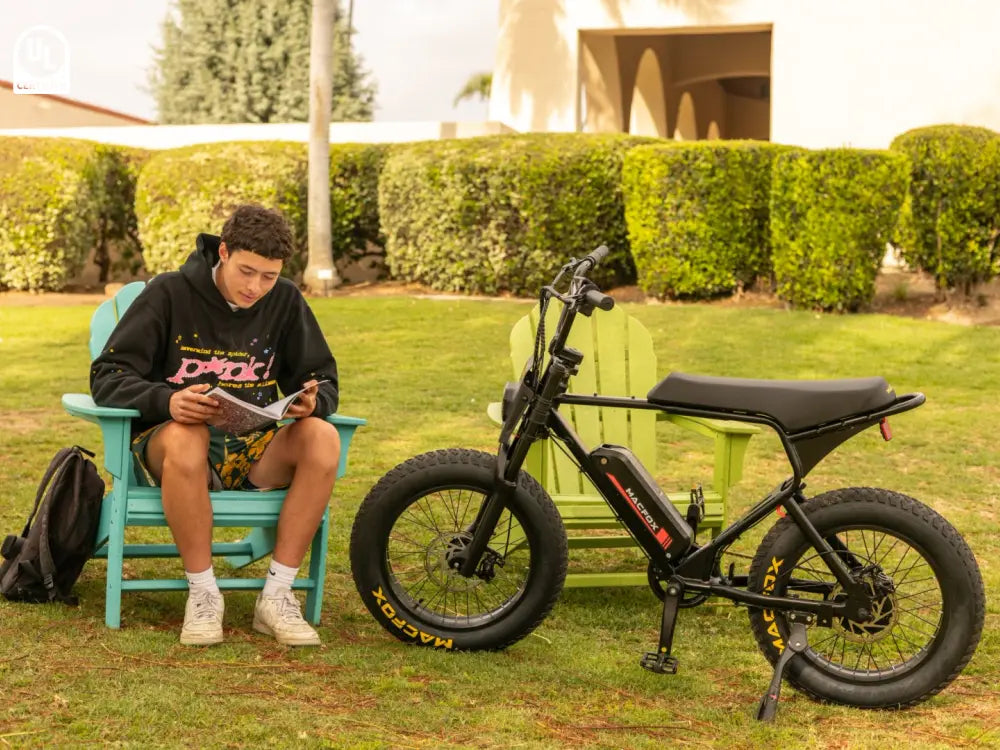
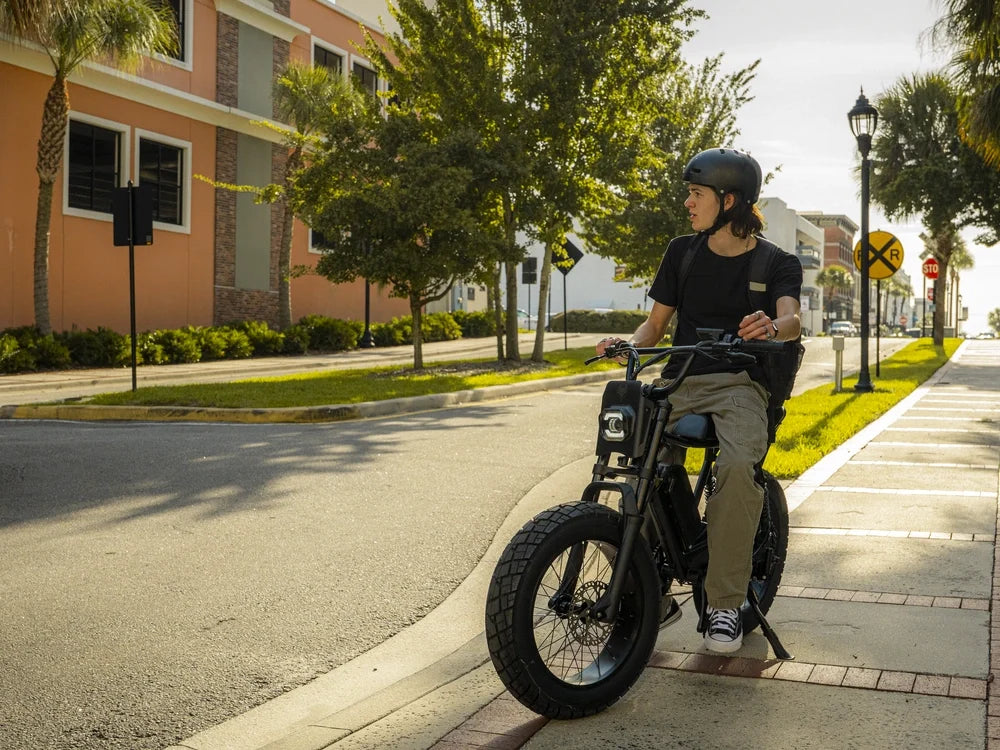
Suspension also amplifies this difference. Popular commuter scooters like the Segway F2 Pro have already introduced front suspension, but many scooters still rely mainly on short-travel suspension structures and the tires themselves for shock absorption. In the commuter e-bike category, models like the Macfox X7 offer up to 65 mm of front fork travel, and when combined with larger wheels and a seated riding position, they are naturally better suited to longer rides.
So if your ride is only 1–2 miles on smooth pavement, the comfort of an electric scooter is usually good enough. But once your commute starts getting closer to 3–5 miles or more, or your route regularly includes cracks, manhole covers, speed bumps, and rough pavement, an electric bike will usually feel noticeably more comfortable.
Learning Curve Comparison
Many people assume scooters are easier because you just stand on them, twist the throttle lightly, and go. But in real riding conditions, small wheels, a standing position, and forward weight transfer under hard braking can all make beginners feel more nervous on wet pavement or in more complex road situations. Electric bikes are larger, but their handling logic is much closer to a regular bicycle. For users who have never ridden a bicycle before, learning to ride an electric bike can be a fairly long process. It may take about a week, and in the beginning, someone may need to support you from behind or alongside you. But for most adult riders, that learning curve is actually more stable over time. So my view is this: a scooter may be easier to pick up at first, but an electric bike is easier to adapt to for the long run.
E-Scooters Vs. E-Bikes:Legal Framework
As mentioned earlier, the legal framework for electric bikes in the U.S. is relatively clearer. At present, 44 states and Washington, D.C. have established electric bicycle classifications in some form, and 37 of those states use the three-class system. In previous articles, we have already explained the definitions and legal requirements of the three classes in detail. Readers who are interested can see: A Guide to Ebike Classes.
By comparison, electric scooter rules are much more fragmented. Minimum rider age, speed limits, sidewalk access, helmet rules, and road-use restrictions are often governed by a mix of state law and local municipal rules. State laws typically define electric scooters as two- or three-wheeled vehicles with handlebars, designed for standing use, weighing under 75 or 100 pounds, with top motor-powered speeds generally no higher than 10–20 mph and motor power usually no more than 1,000–2,000W. The most common rule is that minors are required to wear helmets, while helmet requirements for adults vary widely.
Electric Scooter vs. Electric Bike Cost Comparison
Overall, the cost difference is not huge, but electric scooters are indeed a bit cheaper.
| Cost Category | Electric Scooter | Electric Bike |
|---|---|---|
| Upfront Purchase Price | About $300–$1,500 | About $1,000–$4,000 is the more common practical range; high-end models can reach $6,000+ |
| Budget for a Solid Everyday Model | $500–$900 is often enough for a basic commuter model | $1,500–$2,500 makes it easier to get a dependable commuter bike built for long-term use |
| Electricity Cost per Full Charge | Usually just a few cents to around $0.10 per charge | Usually also just a few cents to around $0.10–$0.20 per charge |
| Battery Replacement | Typically around $150–$400; larger batteries or higher-performance models often run $400–$800+ | Typically around $300–$900; long-range batteries can often cost $1,200+ |
| Ongoing Maintenance | Usually lower; the main concerns are tires, brakes, folding mechanisms, lights, and battery condition | Usually higher; the main concerns are tires, brakes, chain or drivetrain wear, adjustments, and battery condition |
How Should You Choose?
In the end, it comes down to your actual needs. The biggest thing these two have in common is that they are both electric mobility tools that make commuting easier. If what you value most is short-distance transportation, portability, and a low barrier to entry, an electric scooter is usually the better fit. If what you value more is a longer commuting range, a more stable riding experience, and stronger day-to-day practicality, then an electric bike is naturally the more worthwhile choice.
One Electric Bike Worth Considering
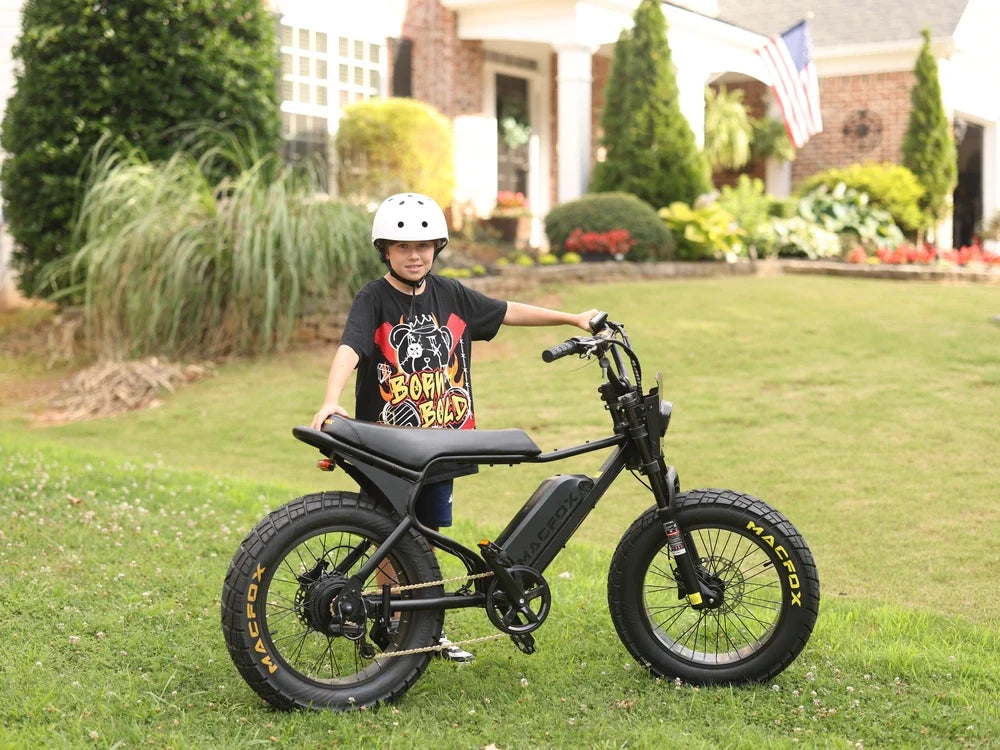
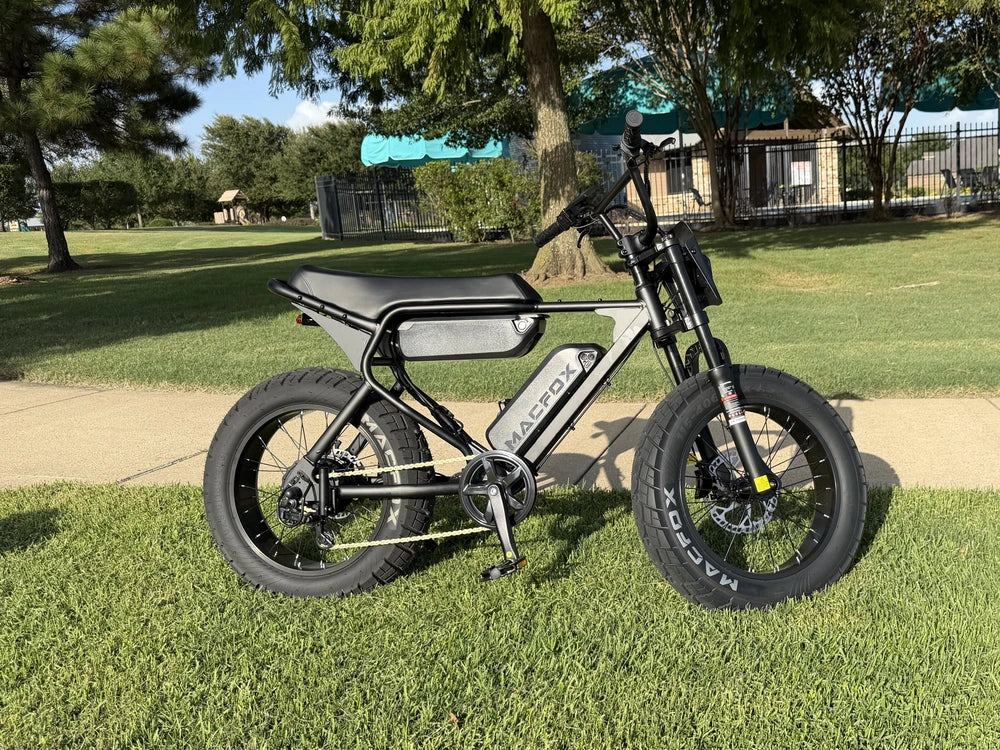
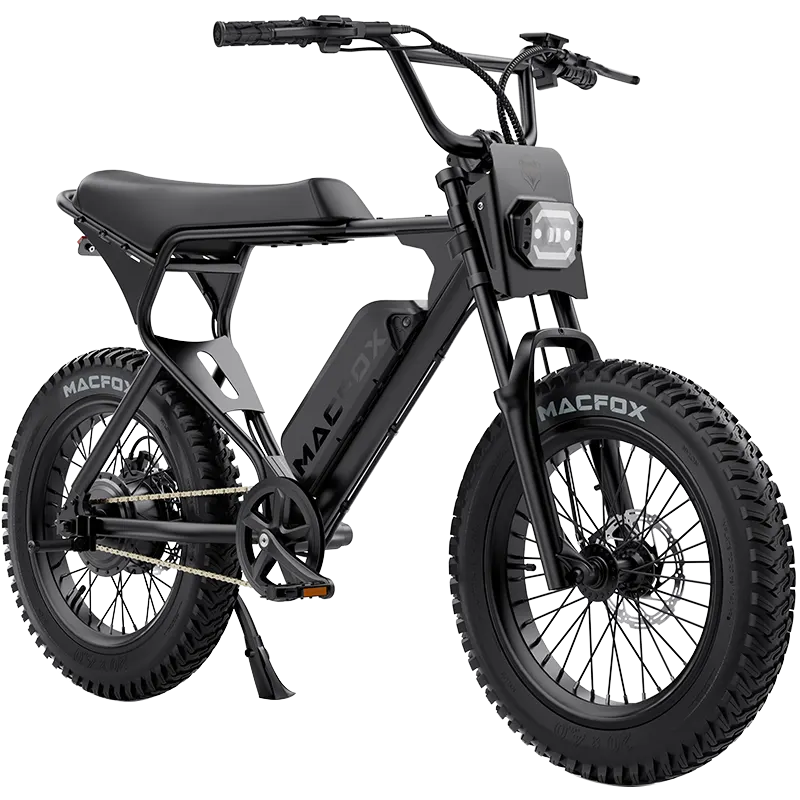
If you are shopping for a daily transportation option for a teenager, and you are deciding between an electric scooter and an electric bike, the Macfox M16 is one model that is especially worth serious consideration. Compared with the stand-up riding position and small-wheel design commonly seen on electric scooters, the M16 uses a seated riding position, 16×4.0-inch wide tires, and front suspension, giving it stronger overall stability, more forgiveness on rougher roads, and better comfort over continuous rides. Add in front and rear mechanical disc brakes, LED front and rear lights, and UL 2849 safety certification, and for parents who care more about daily commuting, rider fit, and a basic sense of safety, it offers clearer advantages over an electric scooter.