
Yes, a 13-year-old can ride an electric bike where local law permits their age group and the bike’s class on the intended route. The bike should fit the 13-year-old rider, and they should be able to brake, steer, and control speed confidently before riding independently.
Ready to compare models? See our ebikes for teens, sized by height.
Quick Answer for Parents
| Question | Practical answer | Parent check |
|---|---|---|
| Can a 13-year-old ride an e-bike? | Yes, where local rules allow a 13-year-old to ride that class on the intended route and the rider can brake, steer, and control speed reliably. | Check state and local rules before riding on roads, bike lanes, parks, or school routes. |
| Is Class 3 appropriate? | A 13-year-old must not operate one where the legal minimum age is higher. | Check the minimum operating age, helmet requirements, and route access—not just whether the rider seems ready. |
| Is throttle use a problem? | It can be if the rider launches too quickly or relies on throttle instead of control. | Require smooth starts, both hands on the bars, and no throttle play near traffic. |
| How can I tell whether my 13-year-old is ready? | Maturity, route, bike fit, braking skill, and supervision. | Watch the rider brake, turn, stop, scan traffic, and follow rules before giving more freedom. |
Understand the Class Before You Say Yes
The e-bike class matters because it changes speed, access, and age concerns. If you are not sure what the labels mean, review the e-bike class guide before choosing a bike for a young teen. Choose only a class that local rules permit a 13-year-old to ride on the intended route.
| Class | Typical assist limit | Considerations for a 13-year-old rider |
|---|---|---|
| Class 1 | Pedal assist up to 20 mph | Pedal assist engages while pedaling; the rider needs to manage starts and speed smoothly. |
| Class 2 | Throttle and/or pedal assist up to 20 mph | Throttle use calls for smooth starts, strict throttle rules, and reliable braking and steering. |
| Class 3 | Commonly pedal assist up to 28 mph; definitions vary by state | A legal minimum age above 13 rules it out, regardless of riding skill or parental permission. |
| Out-of-class bikes | Higher speed, modified limits, or motorcycle-like use | Not a good choice for a 13-year-old on public routes. |
Parents comparing electric bikes should look for the class label, motor rating, assisted top speed, brake type, rider height range, and whether the bike is intended for street, campus, neighborhood, or off-road-style riding. Do not assume a bike is safe for a child just because it has pedals.
Check the Law, Then Check the Route
Where a 13-year-old can ride depends on state and local rules. Some places allow younger riders on Class 1 or Class 2 e-bikes but restrict Class 3 riders to older teens. Others may limit where any e-bike can go, including sidewalks, school property, parks, trails, or certain bike paths. Use the youth e-bike laws guide as a follow-up, then verify the rule where the bike will actually be ridden.
New York, for example, prohibits anyone under 16 from operating an e-bike. California requires Class 3 riders to be at least 16 and riders under 18 to wear a properly fitted and fastened bicycle helmet on public roads or bikeways. Local ordinances in California can also restrict or prohibit e-bike use.
- Street riding: a 13-year-old needs traffic awareness, not just balance and speed control.
- Bike lanes: confirm that the local rule allows the specific e-bike class in that lane.
- School routes: check school policy, parking rules, helmet rules, and where the rider must cross traffic.
- Parks and trails: signs and local ordinances can be stricter than general state law.
- Private property: permission still matters, and unsafe riding can still create injury risk.

How to Tell Whether a 13-Year-Old Is Ready
The rider should be able to stop quickly without skidding, hold a straight line while looking over a shoulder, signal turns, ride without weaving, and slow down before driveways and intersections. If those skills are not consistent on a regular bicycle, the child is not ready for powered riding.
| Ready sign | Why it matters |
|---|---|
| Uses brakes smoothly before turns and crossings | Late braking is one of the fastest ways to lose control. |
| Follows a set route without improvising | Young riders need predictable boundaries before extra independence. |
| Understands when to walk the bike | Busy crosswalks, crowded sidewalks, and blind corners may not be safe to ride through. |
| Keeps both hands on the bars | Keep both hands on the bars except briefly for a safe turn signal, returning to the bars when needed for braking or control; phones and snacks should wait until stopped. |
| Accepts speed limits from a parent | A rider who argues with every rule is not ready for more power. |
Safety Setup Before the First Solo Ride
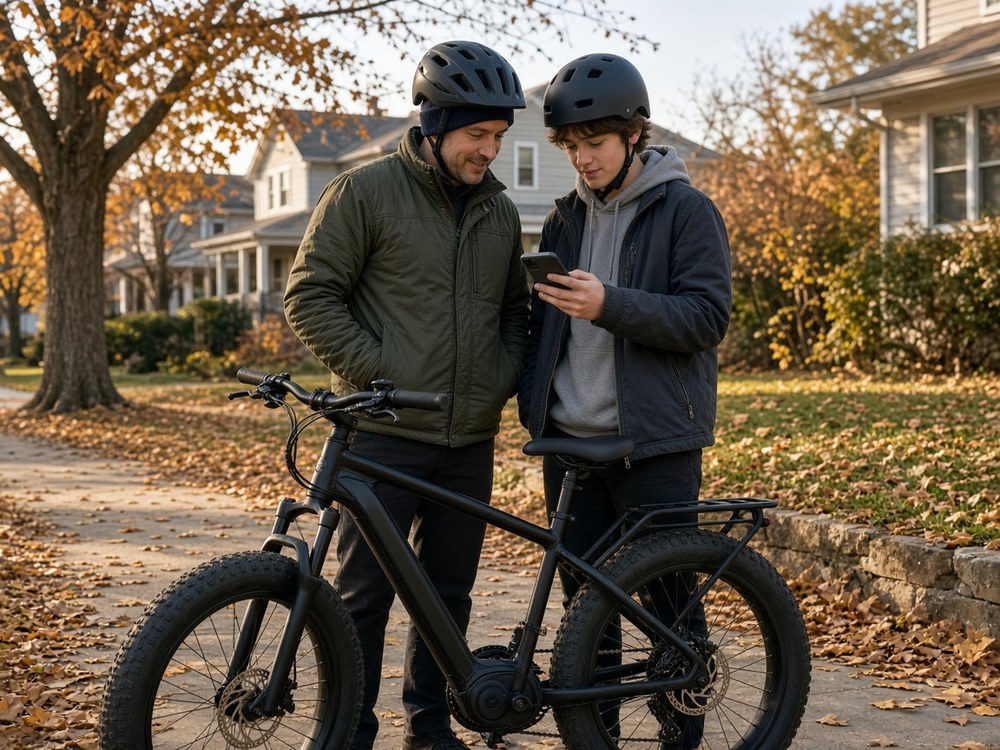
A 13-year-old should not start with a long solo commute. Begin with parent-supervised rides on quiet streets or paths where e-bikes are allowed. Build from short practice sessions to a known route only after the rider shows consistent braking, scanning, and speed control. The teen e-bike safety rules can help turn those expectations into a simple household rule set.
- Helmet every ride: choose a properly fitted bicycle helmet and replace it after a crash.
- Lights and visibility: use front and rear lights, reflective details, and bright clothing near dusk.
- No passenger rule: do not let a young teen carry friends on a bike not built for passengers.
- Speed cap rule: start with the lowest practical assist level and do not chase top speed.
- Weather rule: avoid rain, darkness, ice, and high-traffic times until skills are proven.

Choosing a Bike for a 13-Year-Old
The best bike is not simply the fastest or most powerful one. Start with fit, speed limit, brakes, tire stability, weight, and how easy the controls are for the child to understand. If you are still comparing categories, use the teenager's first e-bike guide for the broader buying decision.
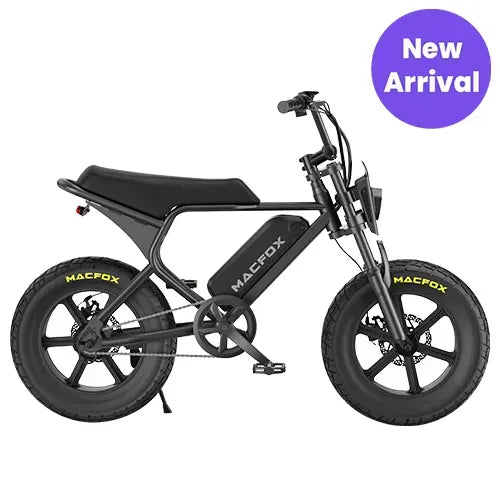
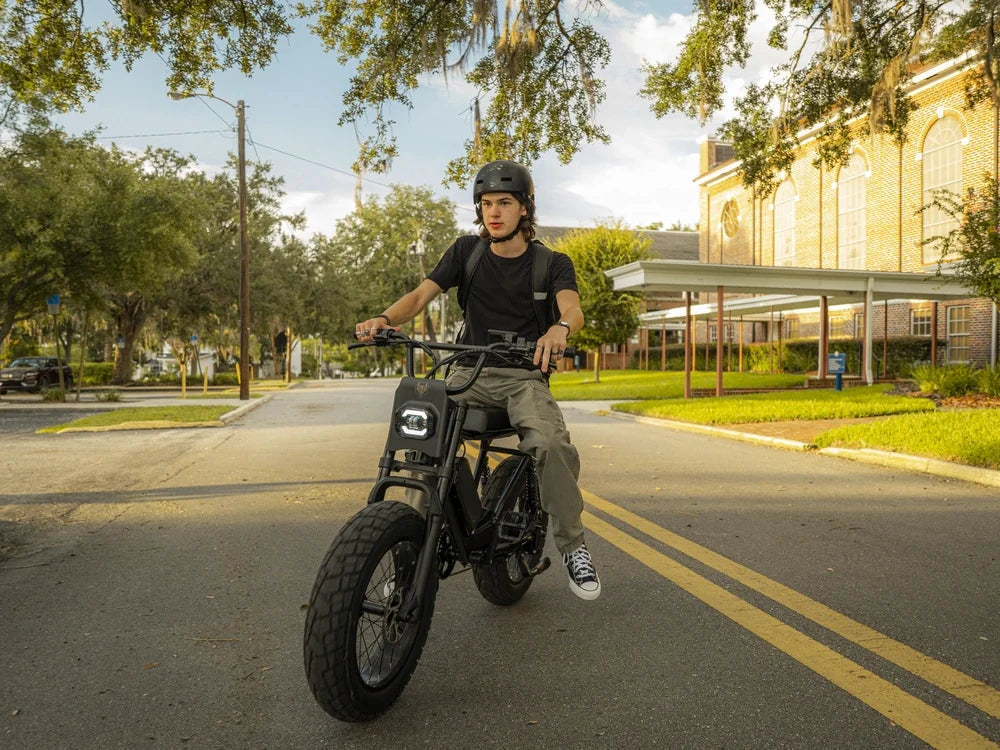
For a smaller teen, the Macfox M16 e-bike is the more youth-focused Macfox option. It is a Class 2 e-bike with a 500W motor, 750W peak power, 20 mph top speed, up to 25 miles of range per charge, 16 x 4 inch fat tires, front suspension, and a recommended rider height from 3'11" and up. Check that the rider can reach the controls and manage the bike through starts, turns, and stops.
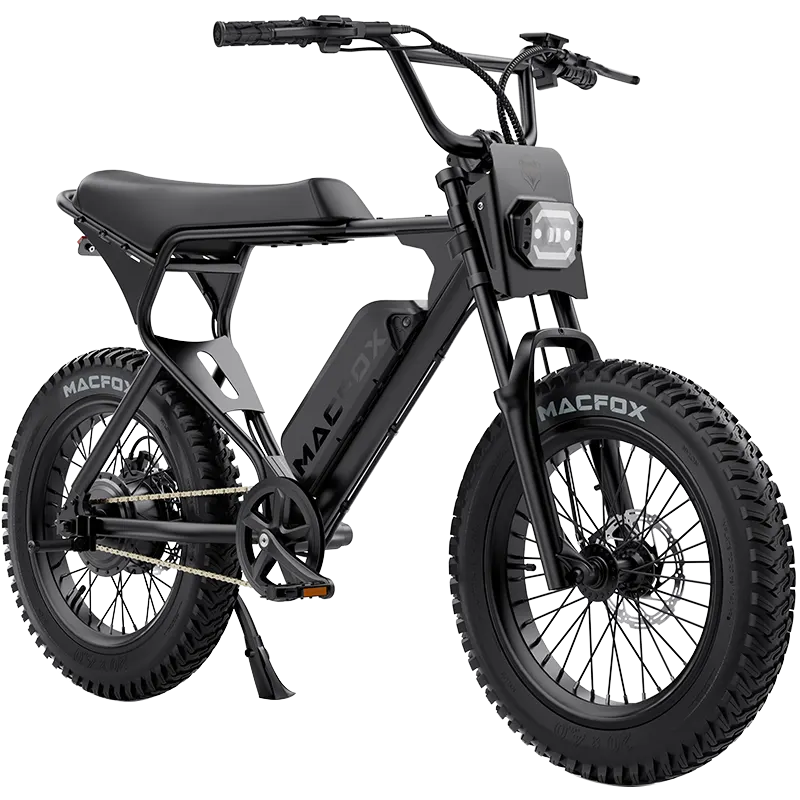
The Macfox X1S e-bike is a larger commuter-style option. It is a Class 2 commuter e-bike with a 500W motor, 750W peak power, 20 mph top speed, up to 28 miles of range per charge or 56 miles with a dual-battery setup, and a recommended rider height from 5'3" and up. That makes it more of a step-up choice for a taller, more experienced teen, not an automatic first e-bike for every 13-year-old.
If throttle control is part of the decision, compare electric bikes with throttle only after the rider can already brake, steer, and follow route rules. A throttle can be convenient, but for a young rider it also requires clear limits on launch speed, hill starts, and where power can be used.

When a 13-Year-Old Should Wait
Waiting is the better choice if the only available route puts the child in fast traffic, if the child cannot control speed without reminders, if the bike does not fit, or if local rules are unclear. It is also better to wait if the rider treats the e-bike like a toy for tricks, racing, or social pressure instead of transportation.
Start with a regular bicycle, or practice with a parent where the 13-year-old is allowed to ride an e-bike. The goal is not to give a 13-year-old the most freedom immediately. The goal is to build enough control that more freedom becomes reasonable.
FAQ
Can a 13-year-old ride a Class 2 e-bike?
Yes, where local rules allow a 13-year-old to ride a Class 2 e-bike on that route. Parents should also judge route, maturity, and throttle control.
Can a 13-year-old ride a Class 3 e-bike?
Not where the legal minimum operating age is above 13. California, for example, requires Class 3 riders to be at least 16. Riding skill, a lower speed setting, or parental permission does not override that age requirement.
Is an e-bike safe for a 13-year-old rider?
It can be a suitable option when the bike fits, the rider can brake and steer reliably, and the route and supervision match those skills. Riding still carries risk. Parents should enforce helmet, visibility, and traffic rules before allowing more independence.
Should a 13-year-old use throttle or pedal assist?
Pedal assist is usually easier to supervise because the rider must keep pedaling. Throttle use can be acceptable only with clear rules, smooth starts, and enough braking control.
Can a 13-year-old ride an e-bike to school?
Yes, if local law, school policy, parking rules, and the route allow it. Parents should ride the route first, identify risky crossings, and set a no-detour rule before approving school commuting.
Bottom Line
A 13-year-old can ride an electric bike where local rules allow it. Choose a bike that fits, require a helmet and visibility, and start with short, parent-supervised rides. Build independence gradually as the rider shows consistent braking, steering, speed control, and respect for the agreed rules.