

In states that use the common three-class system, Class 1 and Class 2 motor assistance generally ends at 20 mph, while Class 3 pedal assistance can continue up to 28 mph depending on the state definition. State and local definitions and access rules still differ. A motor with more watts can help acceleration, hill climbing, and load handling, but wattage alone does not mean the bike is legal or safe to ride faster on public roads.
For most riders, the useful answer is not a race-record number. It is how fast the bike can assist legally, how it behaves on real roads, and whether the setup fits your route. For a separate list of high-speed models, see Macfox's fastest electric bikes guide.
How Fast E-Bikes Really Go
In normal use, commuter and fat tire e-bikes may be set for motor assistance up to 20 mph where the bike's class and local rules support it. A fit rider can pedal faster downhill or with a tailwind, but the motor assistance usually stops at the bike's class limit. That difference matters: bicycle speed, assisted speed, and motor-only throttle speed are not the same thing.
| Speed Question | Practical Answer | What to Check |
|---|---|---|
| How fast do legal Class 1 e-bikes assist? | Usually up to 20 mph with pedal assist. | State class rules, path access, and the label on the bike. |
| How fast do legal Class 2 e-bikes assist? | Usually up to 20 mph and may include throttle operation. | Throttle rules vary by location; compare the e-bike throttle guide. |
| How fast do Class 3 e-bikes assist? | Up to 28 mph with pedal assist, depending on the state definition. | Helmet, age, speedometer, trail, and local access rules. |
| How fast can modified or off-road vehicles go? | They may exceed e-bike class limits, but they may no longer be treated as regular e-bikes. | Vehicle classification, road or trail access, and the manufacturer's warranty terms. |
U.S. E-Bike Speed Limits by Class
Federal consumer-product law defines a low-speed electric bicycle as a two- or three-wheeled vehicle with fully operable pedals and a motor under 750 watts, whose motor-only maximum speed is under 20 mph on a paved level surface under the statute's test conditions. State road and trail rules then decide how e-bikes are classified and where they can be used. Many states use the Class 1, Class 2, and Class 3 framework, but riders still need to check local access rules before assuming a faster setup is allowed.
For a fuller class-by-class explanation, use Macfox's electric bike class guide and then compare your local rule set. If your speed question is really a license or registration question, read e-bike license requirements before riding on public roads.

Motor Wattage vs Real Speed
Wattage affects how strongly the motor can help, but top speed is also limited by controller programming, battery voltage, rider weight, tire size, terrain, wind, gearing, and the bike's configured speed limit. That is why a 500W e-bike and a 750W e-bike can both be limited to 20 mph even when a higher-power build advertises much higher numbers.
More available power may help an e-bike accelerate or hold speed under load, on a hill, or into a headwind, but it does not automatically raise the bike's speed ceiling. Battery state and temperature, rider and cargo load, grade, wind, gearing, and rolling resistance all affect what the rider feels. Motor watts describe power output; battery watt-hours describe stored energy. Neither number alone guarantees a particular top speed or range.
- Compare like with like: use the same route, assist mode, load, and similar weather before deciding the bike has lost performance.
- Check the simple causes first: review battery charge, assist mode, total load, wind, grade, and whether either wheel shows brake rub.
- Keep rolling resistance in check: a soft or underinflated tire or brake rub adds resistance; keep tire pressure within the stated range.
If the change is sudden or comes with unusual heat, noise, braking, battery, or electrical behavior, stop riding and arrange an inspection. Do not install a different-voltage battery or alter the motor or controller simply to raise the displayed speed.
For model-by-model speed details, use the electric bike top speed comparison alongside the legal and real-world limits above.
Macfox Top Speeds: X1S, X7, and X2 Pro
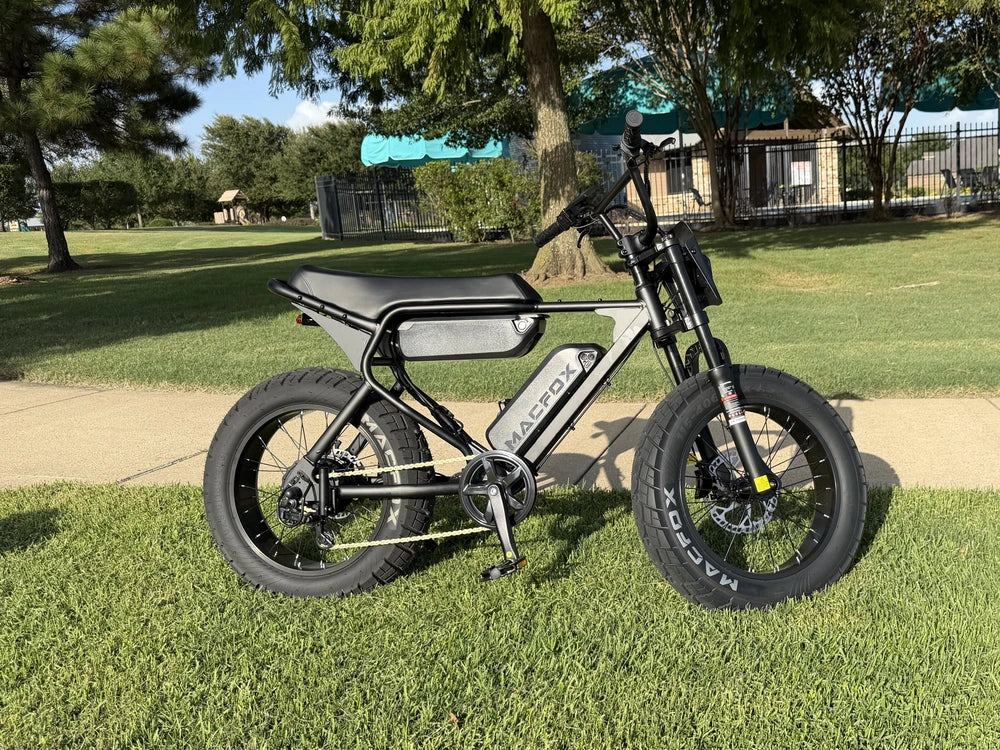
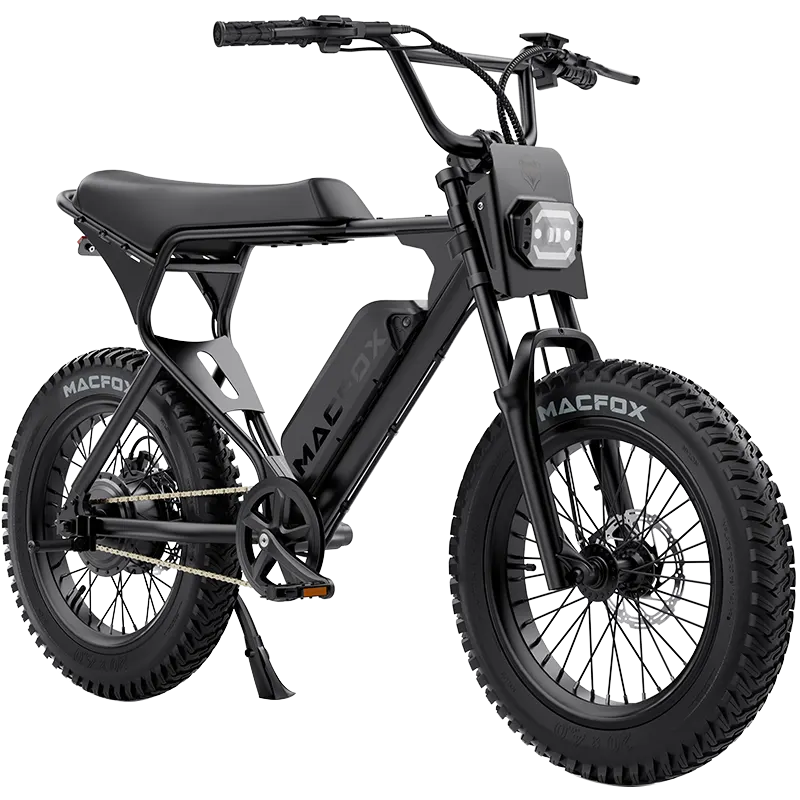
Macfox's current core electric bikes are not positioned as high-speed e-moto models. The current product pages list a 20 mph top speed for the X1S, X7, and X2 Pro, with different motors, tires, suspension, and riding use cases.
The Macfox X1S and X7 each list a 500W motor with 750W peak output; the Macfox X2 Pro lists a 750W motor with 1000W peak output. All three list a 20 mph top speed, so these figures do not make one model faster. Tire size, suspension, gearing, motor response, total weight, and riding position still change how each bike feels. For the full model-by-model breakdown, use the Macfox electric bike top speed comparison.

Why Electric Dirt Bikes Are a Different Question
Searches for electric dirt bikes often mix legal e-bikes with electric motorcycles, off-road vehicles, and modified builds. Those vehicles may be faster, but they are not automatically allowed on bike lanes, multi-use paths, campuses, or public roads.
Before changing a controller, removing a speed limit, or chasing a higher display number, check the vehicle's classification, the manufacturer's instructions and warranty terms, the braking and tire requirements, and the rules for the exact place you plan to ride.
FAQ
How fast can electric bikes go?
In states that use the common three-class system, Class 1 and Class 2 motor assistance generally ends at 20 mph, while Class 3 pedal assistance can continue up to 28 mph depending on the state definition. State and local definitions and access rules still differ. Some modified or off-road electric vehicles can go faster, but they may not be legal e-bikes for public-road or trail use.
How fast are the Macfox X1S, X7, and X2 Pro?
The current Macfox X1S and X7 product pages each list a 20 mph top speed, a 500W motor, and 750W peak output. The Macfox X2 Pro product page lists a 20 mph top speed, a 750W motor, and 1000W peak output. They differ in tires, suspension, and intended riding use rather than listed top speed.
Are faster e-bikes better?
No. For commuting, a stable 20 mph e-bike can be more useful than a faster vehicle if it is legal, comfortable, easy to park, and safe around traffic. Higher speed also increases stopping distance and can reduce access to paths or trails.






2 thoughts on “How Fast Can Electric Bikes Go? Speed Limits and Real-World Factors”
jonmeadow
We have entered the age of technology over-stepping utility, and laws are conforming accordingly! First a sign along a river bike path said “No Motor Vehicles!” Then the sign said, “Maximum recommended speed: 25 miles per hour.” Now! The sign has been taken down.
Denero
Thanks! Very informal. Good work.