
No, e-bikes usually do not use a lot of electricity in everyday riding. A full charge often uses far less energy than running many household appliances for a day, and much less than driving a gasoline car for the same short trip. The real number depends on battery size, charger losses, assist level, hills, rider weight, tire pressure, wind, and how often you use throttle.
The better question is not whether an e-bike is expensive to charge. It is whether your riding style is asking the battery to work harder than it needs to. Two riders can own similar bikes and see different electricity use because one rides flat streets in low assist while the other climbs hills, carries cargo, and accelerates hard from every stop.
How Much Electricity Does an E-Bike Use Per Charge?
A simple way to estimate electricity use is to look at battery watt-hours. A 500Wh battery stores about 0.5 kWh of energy. A 750Wh battery stores about 0.75 kWh. Because chargers are not perfectly efficient, the wall outlet may supply a little more than the battery stores, but the rough scale is still small compared with most vehicle fuel costs.
| Battery size | Approximate stored energy | What it means in practice |
|---|---|---|
| 360Wh | 0.36 kWh | A smaller daily battery for short rides or lighter assist. |
| 500Wh | 0.5 kWh | A common commuter-size reference point. |
| 750Wh | 0.75 kWh | More reserve for hills, heavier riders, or longer rides. |
| Dual battery setup | Varies by model | More stored energy, but also more total charging time and capacity. |
If you want the detailed dollar calculation by electricity rate and battery size, use the e-bike charging cost guide. This article stays focused on whether the power use is high or low in normal riding.
Why Some E-Bikes Seem to Drain Power Faster
Electricity use rises when the motor has to do more work. High assist, frequent throttle use, steep hills, soft tires, low tire pressure, cold weather, heavy cargo, stop-and-go streets, and headwind can all increase energy use. The motor is not wasting power; it is responding to resistance.
- Hills: climbing demands more current than cruising on flat ground.
- Throttle starts: repeated hard launches use more energy than smooth pedal assist.
- Low tire pressure: extra rolling resistance makes the motor work harder.
- Heavy loads: rider weight, locks, bags, groceries, and cargo all count.
- Cold weather: batteries can deliver less usable energy in low temperatures.
For a more technical explanation of watts, watt-hours, assist settings, and per-mile energy use, continue with the e-bike power usage guide. That page is the better place for formulas and deeper power terminology.
Does a Bigger Motor Always Use More Electricity?
Not automatically. A larger motor can use more electricity when the rider uses the extra power, but motor rating alone does not decide total energy use. A 750W motor ridden gently on flat pavement may use less energy than a smaller motor pushed hard up hills. Controller limits, battery voltage, tire choice, rider behavior, and terrain all affect the result.
The safest way to think about it is this: higher power gives more reserve, not a guarantee of higher daily electricity use. The rider still controls a large part of the outcome through assist level, speed, pressure, route choice, and charging habits.
How Much Does Riding Style Change Electricity Use?
| Riding pattern | Typical electricity effect | Better habit |
|---|---|---|
| Low assist on flat routes | Lower consumption | Keep cadence steady and avoid unnecessary hard starts. |
| High assist all ride | Higher consumption | Drop one assist level when cruising. |
| Throttle-heavy riding | Higher consumption | Use pedal assist for starts when possible. |
| Underinflated tires | Higher consumption | Check tire pressure before frequent rides. |
| Long climbs or cargo loads | Higher consumption | Plan battery reserve instead of riding to empty. |
If range anxiety is the main concern, compare route distance, battery size, and assist habits with the Macfox e-bike range guide. Riders who consistently need more reserve may also want to compare a long range electric bike setup rather than judging only by motor wattage.
E-Bike Electricity Use Compared With Cars and Home Devices
For short local trips, an e-bike is usually extremely efficient. It moves one person with a small battery instead of moving a full car, engine, transmission, seats, fuel, and safety structure. That is why the charging cost for an e-bike usually feels minor compared with gasoline, parking, maintenance, and ride-share costs.
The comparison with home devices is also useful. An e-bike charge is measured in fractions of a kWh or around one kWh for larger batteries, while many homes use many kWh per day across heating, cooling, laundry, cooking, computers, and lighting. The e-bike is noticeable on a charger, but it is rarely a major household electricity driver.
Will Charging an E-Bike Show Up on Your Electric Bill?
For most riders, e-bike charging is too small to stand out clearly on a monthly utility bill unless the bike is used heavily or multiple batteries are charged every day. The bill is affected by the whole home: air conditioning, heating, water heating, cooking, laundry, dehumidifiers, computers, and lighting can all move the total more than one small e-bike battery.
That does not mean charging is free or invisible. It means the cost is usually predictable. If you commute daily, charge often, or run a dual-battery setup, track how many full charges you use in a week and multiply by battery kWh and your local electricity rate. That gives a better answer than guessing from the size of the bike.
What Not to Overread From One Bad Range Day
One short-range ride does not prove that the bike uses too much electricity. Wind, tire pressure, hills, cold weather, passenger weight, cargo, and route changes can all make one trip worse than normal. Look for a pattern over several similar rides before assuming the battery or motor has a problem.
A useful check is to repeat a familiar route with normal tire pressure, a full battery, moderate assist, and similar load. If range is still far lower than expected, then inspect the battery, charger, brakes, tires, and drivetrain. If the range returns to normal, the original ride was probably route or condition related rather than a true electricity-use issue.
How to Reduce E-Bike Electricity Use
- Use the lowest assist level that still feels comfortable.
- Pedal through starts instead of relying on throttle every time.
- Keep tires properly inflated for your route and tire type.
- Shift before climbs if your bike has gears.
- Avoid carrying extra weight when you do not need it.
- Charge before the battery is deeply depleted whenever your manual recommends it.
- Store the battery away from extreme heat or cold when practical.
Battery care matters too. If your question is more about lifespan than electricity use, read the Macfox battery life guide before changing your charging routine.
Macfox Examples: Daily Riding vs More Demanding Routes
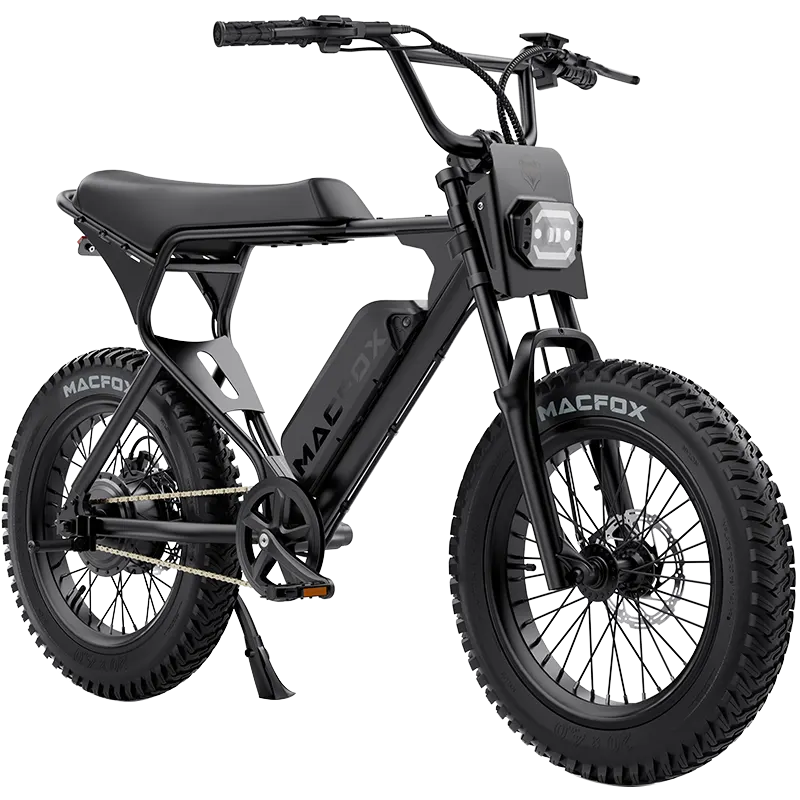
For a daily city rider, the Macfox X1S commuter e-bike is the cleaner example. Its current live product specification lists a Class 2 setup with a 500W motor, 750W peak output, 20 mph top speed, and up to 28 miles per charge, or 56 miles with a dual-battery setup. That fits riders who want a practical commuting reference rather than a high-power off-road setup.
For rougher routes, higher load, or a more planted fat-tire feel, the Macfox X2 electric mountain bike is the stronger comparison point. Its current live product specification lists a 750W motor, 1000W peak output, 65Nm of torque, 20 mph top speed, and 40-80 miles of range depending on battery setup. The point is not that it must use more electricity every ride; the point is that it gives more reserve for harder routes.
When comparing complete bikes, start with the broader electric bike category, then narrow by range, route, rider load, tire feel, throttle needs, and how often you expect to charge.
When Electricity Use Should Actually Worry You
Electricity use is usually not the main problem unless the battery drains much faster than expected, the charger becomes unusually hot, range suddenly drops, or the bike needs far more charging than your route should require. In that case, look beyond normal consumption. Check tire pressure, brake drag, battery age, charger condition, cold-weather storage, controller settings, and whether the bike is being ridden above its intended workload.
A sudden range drop is not the same as normal electricity use. It can point to an aging battery, poor charging practice, a damaged charger, a brake rubbing against the rotor, low pressure, or a route that changed without you noticing. Fixing those issues can matter more than changing the bike.
FAQ
Do e-bikes use a lot of electricity?
Usually no. Most e-bike charges use a small amount of electricity compared with a car trip or total household daily use. Battery size, riding style, hills, cargo, and weather decide the exact amount.
How much electricity does an e-bike use per full charge?
Use the battery watt-hours as the rough guide. A 500Wh battery stores about 0.5 kWh, while a 750Wh battery stores about 0.75 kWh. Charger losses can make wall-outlet use slightly higher.
Does using throttle drain the battery faster?
Often yes, especially from stops or on hills. Throttle can be convenient, but smooth pedal assist usually uses less energy for the same route.
Does a 750W e-bike always cost more to charge than a 500W e-bike?
Not always. Battery size and how much energy you actually use matter more than motor rating alone. A larger motor ridden gently may not use more electricity than a smaller motor pushed hard.
Should I charge my e-bike after every ride?
Follow the battery manual first. For many riders, topping up before the next important ride is practical, but long-term storage, extreme temperatures, and deep discharge need more care than normal daily charging.
Bottom Line
An e-bike is usually a low-electricity way to handle short trips, commuting, errands, and local rides. The biggest changes come from battery size, terrain, assist level, throttle use, tire pressure, rider load, and battery condition. If the bike is healthy and the route is reasonable, electricity use should be a small part of ownership, not the main cost.