

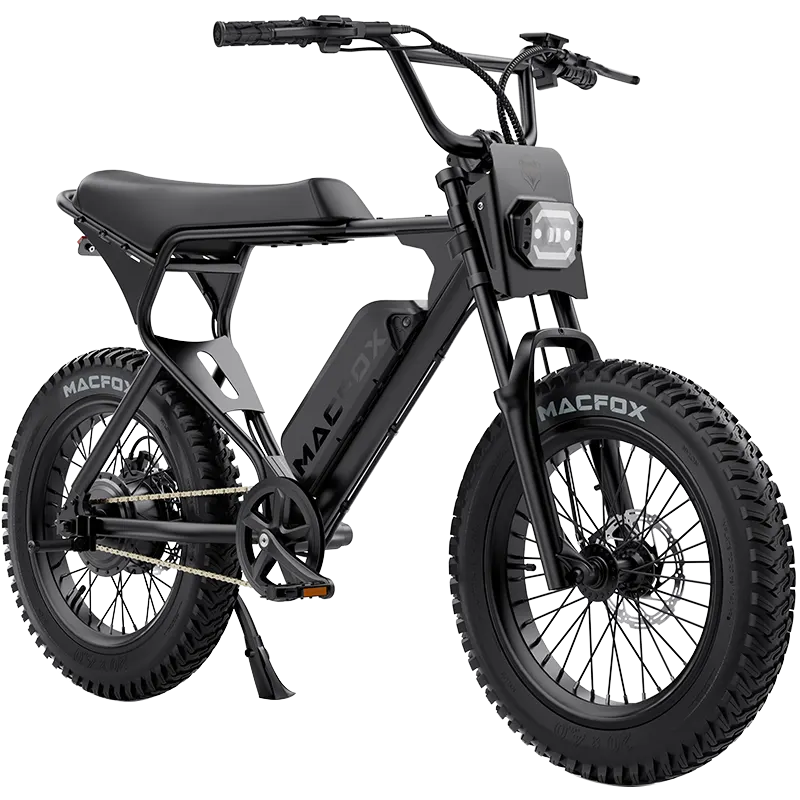
Electric bike commuting distance should be planned as a complete round trip, not as a one-way mileage claim. The current Macfox X1S product page lists up to 28 miles with one battery and up to 56 miles with a dual-battery setup under standard test conditions. Those figures are upper planning references, not guaranteed daily results, so a rider should not build a commute around reaching the final estimated mile.
Start with the full route, include regular stops and detours, then leave room for hills, wind, cargo, temperature, tire pressure, assistance use, and battery condition. If the normal trip sits close to the published limit, dependable charging or the dual-battery configuration provides more planning room.

Electric Bike Commuting Distance: The Short Answer
There is no single mileage that works for every rider. A practical commute is one that the selected battery setup can complete repeatedly without depending on the published maximum.
| Planning input | What to count | Why it matters |
|---|---|---|
| Complete round trip | Outbound distance, return distance, and regular stops | A one-way figure covers only half of the daily battery demand |
| Detours | Common errands, route changes, and missed turns | The normal route is rarely identical every day |
| Reserve | Room between the planned trip and the published estimate | Real conditions can reduce usable distance |
| Charging | Only outlets and charging time that are actually dependable | An assumed workplace outlet is not a route plan |
Use the Current X1S Range as a Reference
The X1S can reach up to 28 miles on a full charge under standard test conditions, including an average rider weight and steady cruising in second gear. The current dual-battery setup is rated up to 56 miles. A route with frequent stops, climbs, stronger assistance, wind, soft surfaces, cargo, or colder conditions may produce a different result.
| Current X1S setup | Published reference | How to use it for a commute |
|---|---|---|
| Single battery | Up to 28 miles | Compare the full daily route with 28 miles and leave room for normal variation |
| Dual-battery setup | Up to 56 miles | Consider it when the usual route leaves too little room under the single-battery reference or charging is uncertain |
| Published charge time | 5–6 hours | Count destination charging only when the correct charger, outlet access, and enough time are dependable |
Check the current battery options and product details on the Macfox X1S page before ordering.
Turn One-Way Miles Into a Daily Plan
For a route that returns along the same path, begin with this simple calculation:
Daily route distance = (one-way distance × 2) + regular detours
The table below compares common route lengths with the current X1S published references. The remaining miles are arithmetic headroom against an upper estimate; they are not a promise of battery capacity left at the end of a ride.
| One-way route | Basic round trip | Comparison with X1S references | Planning takeaway |
|---|---|---|---|
| 5 miles | 10 miles | 18 miles below the single-battery upper reference | Add normal detours and test the route under typical conditions |
| 10 miles | 20 miles | 8 miles below the single-battery upper reference | Check whether hills, wind, cargo, and assistance use make that room sufficient |
| 12 miles | 24 miles | 4 miles below the single-battery upper reference | The route is close enough to the maximum that dependable charging or dual batteries deserve consideration |
| 14 miles | 28 miles | Equal to the single-battery upper reference | Do not plan the daily commute around reaching the published maximum |
| 20 miles | 40 miles | Above the single-battery reference and 16 miles below the dual-battery upper reference | Evaluate the dual setup or a verified charging stop, then test the complete route |
What Changes Real Commuting Distance?
Assistance and Throttle Use
Stronger assistance and frequent throttle use can draw more energy than steady riding at a lower assistance level. Plan around the way the rider will actually use the bike, not an unfamiliar test setting chosen only to extend range.
Stops, Hills, Wind, and Surface
Repeated starts, sustained climbs, headwinds, and soft or uneven surfaces can increase demand. A flat route with steady movement is not a substitute for testing a stop-and-go commute.
Cargo, Tire Pressure, and Bike Setup
Added load, low tire pressure, brake drag, and poor adjustment can change efficiency. Use the load and accessories that will be present during the normal commute when testing the route.
Temperature and Battery Condition
Temperature and battery condition can change usable range. Leave more room when conditions vary, and do not treat a result from one mild day as a year-round guarantee.
For the distinction between published estimates and practical route planning, use the electric bike range comparison.
Choose Single or Dual Batteries by the Route
The single-battery X1S is the clearer starting point when the complete route remains comfortably below its published reference and charging between rides is dependable. The dual-battery setup becomes more relevant when the round trip, regular detours, and real conditions leave too little room under 28 miles.
More published range does not remove the need to check fit, storage, charging routine, and the complete bike configuration. The useful question is whether the additional battery range solves a recurring route problem. Riders comparing other current commuting options can browse commuter electric bikes. For a broader view beyond commuter-specific options, compare current electric bikes.
Test the Commute Before Depending on It
- Map the complete route. Include the return trip, regular stops, and realistic detours.
- Use the normal setup. Carry the usual cargo, set the tires correctly, and ride with the assistance level expected on workdays.
- Start fully charged. Confirm the battery indicator and use the correct charger and charging instructions.
- Ride the whole route. A one-way test cannot show whether the return leg is reliable.
- Repeat in representative conditions. Compare results when wind, temperature, traffic, or load changes.
- Keep a backup plan during the trial. Do not make the first full-distance test the only way to arrive or return on time.
If repeated tests finish with adequate room under the same setup, the route has stronger evidence than a published maximum alone. If the result is consistently close to empty, change the charging plan or battery configuration before relying on the commute.
Frequently Asked Questions
How far can the Macfox X1S commute?
The current X1S is rated up to 28 miles with one battery and up to 56 miles with the dual-battery setup under standard test conditions. A rider's repeatable commuting distance depends on the complete route, conditions, assistance use, load, tire pressure, and battery condition.
Can the X1S handle a 10-mile one-way commute?
A 10-mile one-way route creates a basic 20-mile round trip before detours. That is 8 miles below the 28-mile single-battery upper reference, but the remaining difference is not guaranteed usable range. Test the full route with the normal load and settings before depending on it.
Should workplace charging be included in the plan?
Only when the rider has confirmed outlet access, permission, enough time, and the correct charger. The X1S product page lists a 5–6 hour charge time, so an assumed short stop should not be treated as a full recharge.
When does the dual-battery setup make sense?
It is worth considering when the normal round trip and detours sit too close to the 28-mile single-battery reference, when conditions regularly increase demand, or when dependable destination charging is unavailable.
Does a 500W motor determine commuting range?
No. Motor output and range answer different questions. Commuting distance depends on the complete battery-and-bike system, route, assistance use, load, conditions, and battery state.
Conclusion
Plan electric bike commuting distance from the full daily route: round trip, detours, real conditions, and reserve. Use the X1S figures of up to 28 miles with one battery and up to 56 miles with dual batteries as upper references, then verify the route before making it routine. A dependable commute is one that works without asking the battery to reach its published limit every day.






1 thought on “Electric Bike Commuting Distance: Plan Your Macfox X1S Route”
Guy Irvis
My son has gotten into the display panel settings by using the code all nines. He was trying to reset the delay on the throttle, but he changed some things. I need to know how to reset it or a list of the codes I own a Mac fox X1
Please help me. I am attempting to do a review so far I have good things to say thank you very much.