
There is no single nationwide road-use speed limit for every e-bike in the United States. In states that use the common three-class system, motor assistance usually stops at 20 mph for Class 1 and Class 2 and at 28 mph for Class 3. Those figures are motor-assistance cutoffs, not permission to ride at that speed on every street, bike path, trail, park, or campus.
State law defines the vehicle class, while cities, counties, transportation agencies, and land managers may set stricter route rules. New York is an important exception: its Class 3 category is limited to New York City, uses throttle assistance, and stops at 25 mph rather than the common 28 mph Class 3 cutoff.
This guide was checked against official sources on August 21, 2026. Rules can change, so confirm the current state code and the agency responsible for the specific route before riding.
Common U.S. E-Bike Motor-Assistance Cutoffs
The table below is a starting point, not a nationwide access rule. If you need a fuller explanation of pedal assist, throttle operation, and class labels, read the electric bike class guide.
| Class | Common Motor-Assistance Cutoff | How the Motor Assists | What Still Needs a Local Check |
|---|---|---|---|
| Class 1 | 20 mph | Pedal assist only | Bike-path, trail, park, and campus access |
| Class 2 | 20 mph | Throttle capable | Whether throttle use is allowed on the route |
| Class 3 | 28 mph where the common definition is used | Pedal assist | Age, helmet, speedometer, and path restrictions |

The graphic shows the common three-class framework. It does not replace state law or route-specific rules.
Federal Product Rules Are Not a Nationwide Road-Access Rule
Federal law defines a low-speed electric bicycle for consumer-product purposes as a two- or three-wheeled vehicle with operable pedals, a motor under 750W, and a motor-only speed below 20 mph under specified test conditions. That definition does not create a nationwide Class 1, Class 2, or Class 3 road-access system.
Road use is mainly governed by state and local rules. A seller's “street legal” label is therefore only a starting point. The bike still needs to match the rules where it will actually be ridden.
Five State Examples: Verified August 21, 2026
These five examples show why the same e-bike can be treated differently by location. This is not a complete 50-state table.
| State | Class and Assistance Cutoffs | Rider or Equipment Rule | Access Boundary |
|---|---|---|---|
| California | Class 1 and Class 2: 20 mph. Class 3 pedal assist: 28 mph. Motor no greater than 750W. | Riders under 16 may not operate Class 3. Class 3 riders and passengers must wear a helmet. | A local authority or public agency with jurisdiction may prohibit e-bikes on equestrian, hiking, or recreational trails. California State Parks may also restrict e-bikes on bike paths or trails under its jurisdiction. |
| New York | Class 1 pedal assist and Class 2 throttle assist: 20 mph. Class 3 is a throttle-capable category limited to New York City and 25 mph. | Operators must be at least 16. Class 3 riders must wear a helmet. | E-bikes may be operated on highways with a posted speed limit of 30 mph or less unless a local rule provides otherwise. Public-land or greenway access requires express permission. |
| Texas | Class 1 and Class 2: 20 mph or less. Class 3: pedal assist above 20 mph but below 28 mph. Overall top assisted speed is 28 mph or less; motor is under 750W. | Class 3 operators must be at least 15. | Separate path speed and access rules may apply. |
| Florida | Class 1 and Class 2: 20 mph. Class 3 pedal assist: 28 mph. Motor is under 750W. | State law generally treats an e-bike like a bicycle. | Local governments and land managers may restrict streets, sidewalks, paths, trails, beaches, or dunes. |
| Washington | Class 1 and Class 2: 20 mph. Class 3 pedal assist: 28 mph. Motor no greater than 750W. | Class 3 requires a speedometer. Riders under 16 may not operate Class 3. | Class 3 is not allowed on a shared-use path unless a local authority permits it. E-bikes are not allowed on natural-surface trails designated for nonmotorized use unless the managing authority permits them. |
Class Cutoff, Posted Speed, and Route Access Are Different Rules
| Question | What It Means | Where to Check |
|---|---|---|
| When does motor assistance stop? | The class cutoff, such as 20 mph or 28 mph. | State class definition and the bike's label or manual |
| How fast may anyone travel on this route? | The posted or route-specific speed limit can be lower than the class cutoff. | Road signs, path rules, park rules, or campus rules |
| Is this class allowed here? | A route may allow one class and restrict another. | City, county, transportation agency, or land manager |
| Is throttle use allowed? | Throttle capability can affect classification and access even when the speed number is unchanged. | State definition plus the specific route rule |
For the difference between pedal assist and throttle operation, use the throttle electric bike guide.
Speed, Power, and Voltage Are Not the Same Thing
Speed-limit searches often turn into wattage and voltage questions. That is where many buyers get misled. Motor wattage, battery voltage, and controller behavior can affect acceleration and hill feel, but those specifications do not automatically change the motor-assistance cutoff or make a bike legal on every public route.
| Spec | What It Can Affect | What It Does Not Decide Alone |
|---|---|---|
| Motor wattage | Acceleration, climbing help, and load handling. | Whether a bike is Class 1, Class 2, Class 3, or legal on a specific path. |
| Battery voltage | How the system delivers power under load. | The legal assisted-speed cutoff. |
| Controller settings | Current delivery, throttle response, and speed cutoff behavior. | Whether a modified bike remains street legal or warranty safe. |
| Display speed | What the rider sees while moving. | Permission to ride faster than the local speed or class rule. |
If your question is how motor power and riding conditions affect actual speed, use the electric bike speed guide. Changes to a controller, motor, throttle, or assistance cutoff can affect classification, warranty support, and route access, so do not treat them as a normal public-road upgrade.
Class 2, Throttle Use, and the 20 mph Question
Class 2 is where many riders get confused. A throttle can be very useful for starts, traffic gaps, hills, and riders who need easier launches, but the throttle does not make the bike a free-speed vehicle. In many class systems, Class 2 motor assistance still stops at 20 mph.
A common rider scenario is buying a throttle e-bike for commuting and assuming that a 28 mph claim applies to throttle operation. That is often the wrong assumption. Check whether the bike's throttle, pedal assist, and controller are limited separately. If throttle use is your main reason for buying, compare the electric bike with throttle category and keep the local speed rule in mind.
When Is an E-Bike Legal on a Specific Route?
A class label is a starting point, not proof that an e-bike is allowed everywhere. Confirm the motor rating, assistance cutoff, throttle behavior, required equipment, and rider-age rules in the state where you ride. Then check the rules for the exact road, bike lane, path, trail, park, beach, or campus.
For license and registration questions, use the e-bike license guide. For roadway access questions, use the e-bike roadway access guide. Posted limits and local restrictions still apply.
Comparing Current Macfox Models After You Check Local Rules
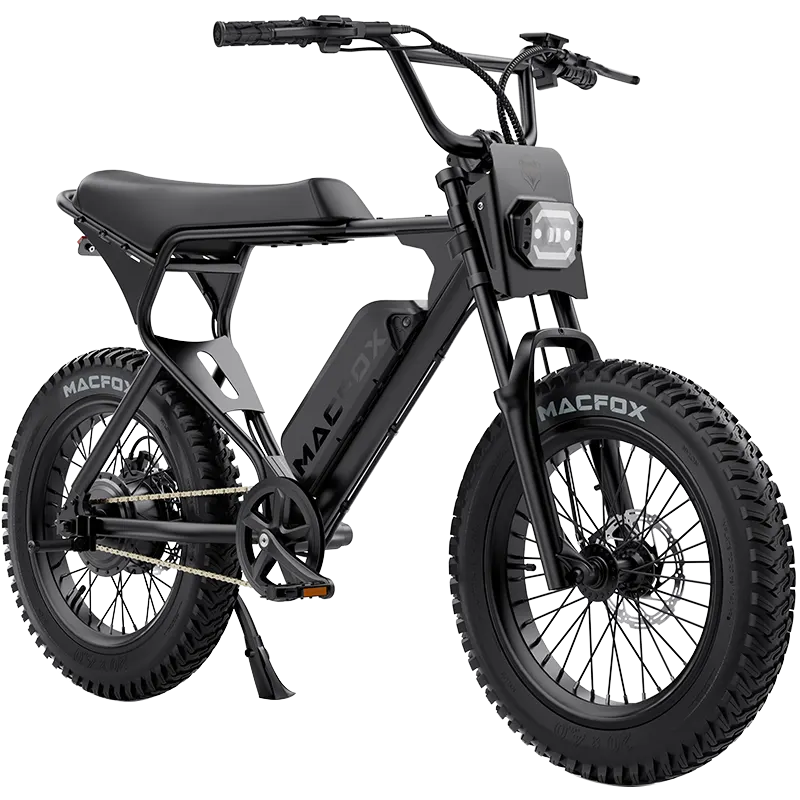
After checking the rules for the routes you use, compare the Macfox X1S and X7 by intended use, rider fit, braking, tire setup, and the final configuration stated on the product page. A speed specification or product label alone does not prove that a bike is allowed on a specific route.
| Model | What to Compare | Confirm Before Riding |
|---|---|---|
| Macfox X1S commuter e-bike | Commuter geometry, rider fit, braking, controls, and published configuration. | Class label, throttle behavior, equipment requirements, and access on the exact route. |
| Macfox X7 fat tire e-bike | Fat-tire setup, rider fit, braking, controls, and published configuration. | Class label, throttle behavior, equipment requirements, and access on the exact route. |

How to Check the Speed Limit Before You Ride
- Find the class label: confirm whether the bike is Class 1, Class 2, Class 3, or outside the normal class system.
- Check assisted-speed cutoff: know whether assistance stops at 20 mph, 28 mph, or another setting.
- Separate throttle from pedal assist: throttle behavior can matter more than motor wattage for access.
- Check the route: roads, bike lanes, multi-use paths, state parks, campuses, and trails can have different rules.
- Do not rely on a seller claim alone: a listing that says "street legal" should still match your state and local rules.
- Ride for conditions: even when motor assistance is permitted up to the class cutoff, follow any lower posted limit and slow down around pedestrians, blind corners, and crowded paths.
E-Bike Speed Limit FAQ
What is the legal speed limit for an e-bike in the United States?
There is no single nationwide road-use speed limit for every e-bike. In the common three-class framework, assistance usually stops at 20 mph for Class 1 and Class 2 and at 28 mph for Class 3, but state definitions and local route rules can differ.
Is 28 mph legal everywhere for a Class 3 e-bike?
No. Some states do not use the common 28 mph Class 3 definition, and local rules may restrict where Class 3 e-bikes can be ridden. New York, for example, uses a 25 mph throttle-capable Class 3 category limited to New York City.
Does a 750W motor mean an e-bike can legally assist to 28 mph?
No. Motor wattage alone does not determine the class or legal assistance cutoff.
Can a Class 2 throttle e-bike use a bike path?
Sometimes, but not everywhere. Check the state definition and the rule for the specific path, park, trail, or campus.
Can I unlock an e-bike for public-road use?
Do not assume an unlocked or modified bike remains in its original class. A change to the motor, controller, throttle behavior, or assistance cutoff can affect classification, access, warranty support, and safe stopping requirements.
Where should I verify the current rule?
Check the current state code, then confirm the rules published by the city, county, transportation agency, park, trail, campus, or other authority responsible for the route.